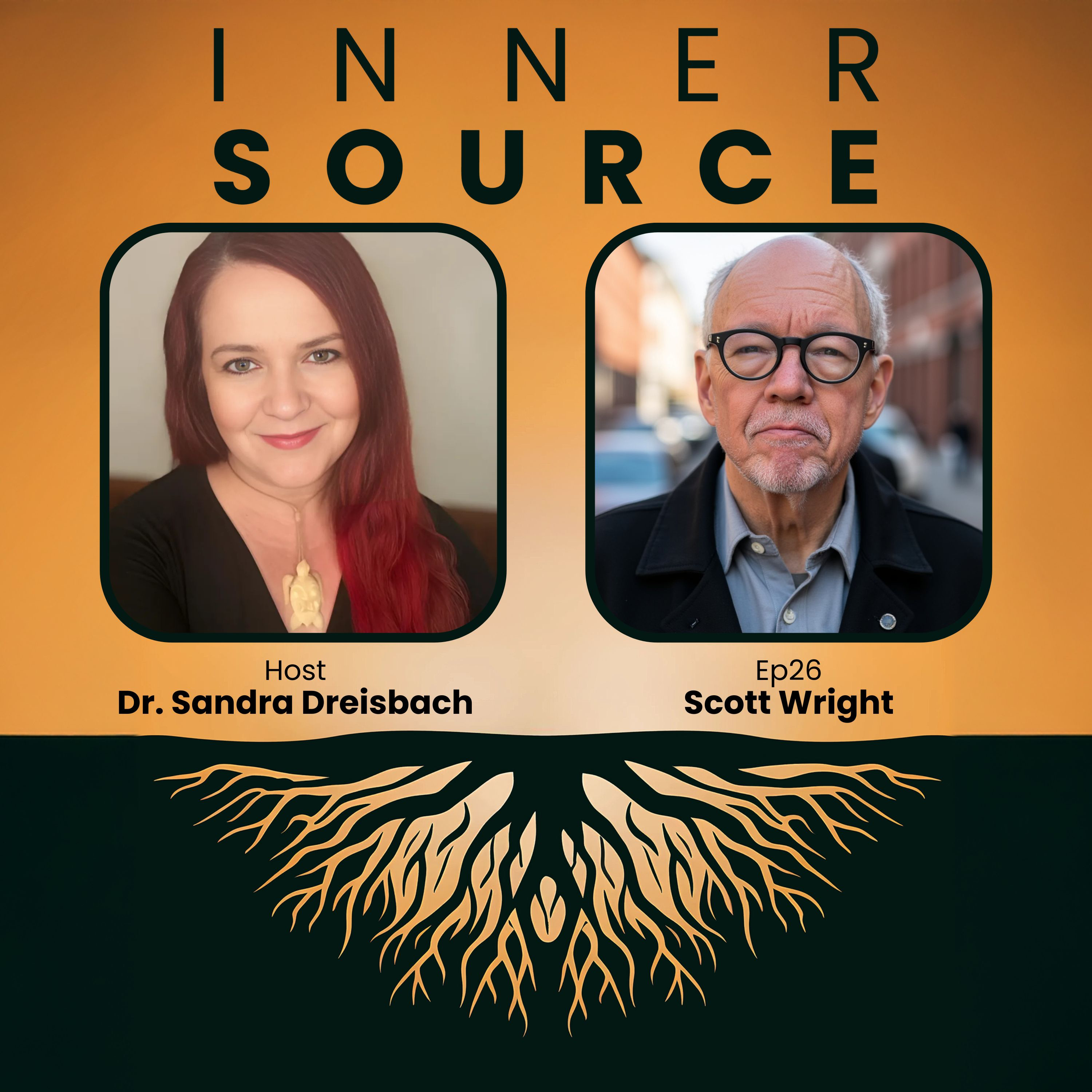
Ep26 Scott Wright—A Filmmaker's Own Awakening, Decades of Silence Breaking Open, and the Medicine of Connection
What if the most powerful kind of healing doesn't arrive until the second half of life?
That question sits at the heart of this conversation between Dr. Sandra Dreisbach and Scott Wright, documentary filmmaker; former radio DJ known across America as "The Shadow," and director of The Next Chapter: Psychedelics, Healing, and the Second Half of Life, premiering this June in Toronto.
Scott didn't set out to make a film about psychedelics. He set out to understand his own life: the decades of insecurity and self-judgment that shaped how he showed up for the people closest to him. A single journey in Mexico cracked something open, and what came out the other side was a documentary following eight people in their late fifties through their late sixties as they faced down a lifetime of buried grief, trauma, and one question almost everyone eventually asks. What is my life about now?
In this conversation, Scott and Dr. Sandra talk about what it actually looks like to do "the work" later in life. What does it take to let go of decades of armor you didn't even know you were wearing? What happens when eight strangers go through something this intense together and are still calling each other two years later? They talk about growing up in a generation that treated therapy as something only "broken" people needed and about the message Scott hopes people take from his film: that healing is still available to you, no matter how long you've been carrying what you carry and no matter how old you are when you finally set it down.
If you've ever wondered whether it's too late for you to change, this conversation is worth your full attention.
______________________________
**Disclaimer** The information shared on this podcast, our website, and other platforms may be triggering for some viewers and readers and is for informational, educational, and entertainment purposes only. It is not a substitute for professional medical, legal, or therapeutic advice. While we explore topics related to altered states of consciousness, we do not endorse or encourage illegal activities or substance use. Always research your local laws and consult qualified professionals for guidance. The content provided is "as is," and we are not liable for any actions taken based on the information shared. Stay supported and informed, act responsibly, and enjoy the podcast!
Scott Wright 0:00
The biggest overall message is one of hope and healing, for people to realize that there is an opportunity to get beyond the stuff that has been really tearing people down for decades. Here's some way that maybe can really relieve their burden, open things up for them, help them get past whatever it is they've been struggling with, there is healing available.
Dr. Sandra Dreisbach 0:23
Welcome to Inner Source. I'm Dr. Sandra Dreisbach. Whether you're just beginning to explore your inner landscape or you've been doing this work for years and understand that transformation is a lifelong journey, this is your space. We're diving into real conversations about personal growth, shadow work, and what it actually takes to create lasting change from the inside out. Because the truth, your most powerful healing tool, isn't out there somewhere, it's already within you. Let's connect to that inner source together. The
Speaker 1 1:00
information shared on this podcast, our website, and other platforms may be triggering for some viewers and readers, and is for informational, educational, and entertainment purposes only. It is not a substitute for professional medical, legal, or therapeutic advice. While we explore topics related to altered states of consciousness, we do not endorse or encourage illegal activities or substance use. Always research your local laws and consult qualified professionals for guidance. The content provided is as is, and we are not liable for any actions taken based on the information shared. Stay supported and informed, act responsibly, and enjoy the podcast.
Dr. Sandra Dreisbach 1:31
In today's episode, I talk with filmmaker Scott Wright. Now, Scott Wright didn't start doing documentaries; he actually started by doing 25 years in radio, rising from his high school station, suburban Chicago, to become America's most listened to DJ in the 1980s on z1 100 in New York, and his nationally syndicated hit line USA. Listeners knew him as Shadow Steele, or simply The Shadow. The Shadow does know, I guess he's one of a handful who's topped the radio ratings in America's three biggest markets, New York, LA, and Chicago. He went on to be a national programming executive for major radio chain, and then a marketing and promotion executive for major labels in the record industry. Switching to film, he produced and directed Three Days of Glory, a feature documentary that premiered on Hulu in 2018 now streaming on Tubi, and created and produced the rock documentary John Waite the Hard Way, released in late 2022 and currently streaming on Amazon Prime Video. Scott and his wife Martha split their time in an apartment in Paris, which is where I meet with him today to talk with a condo in New Orleans and a cabin on the White Salmon River in Washington state, but today we're in Paris. His latest film, which is what we spend most of our time discussing, is the next chapter, psychedelics, healing, and the second half of life, which is being released this June, probably when you're going to be hearing this. This particular episode, we're going to, we're going to wait a little bit, just so you can be able to hear it right beforehand, because it looks like it's coming out just before solstice, and I love that Scott Wright's energy, his commitment, his own story of his own personal experience, his own inner source and journey with psychedelics and plant medicines that came to him later in life, and and then inspired him to be able to create this documentary, and then later his wife ends up even joining him in the experience, and now, now, now, the world gets to see how he shifted, and how that is now creating shift for others, and he really wants to talk to people about why people who are of an older age group, why they can also still receive healing and transformation, and a time in life when people are expected to just retire and just, you know, go away. In a lot of Western culture, unfortunately, I don't feel like we do enough to treasure our elders, but the idea that we're now in a generation that embraces more healing and transformation and connecting to our inner source and guidance, that it's never too late. So, I love this story. I love.. I haven't had a chance to see the documentary yet, as you'll hear in this in this podcast, but I imagine it's going to be amazing, and I look forward to watching it, and I hope you enjoy this conversation, this really honest and frank conversation between Scott and I about this documentary on psychedelic healing for people who are elderly. First, well, I'm very grateful to have you here today, Scott. I love that we got to connect and hear about your work, and I want to hear a bit about this journey you've had with this documentary on psychedelic therapy, but I first want you to be able to share anything you want to share about yourself, like, how did you end up getting to do documentary work? What was your personal journey about film?
Scott Wright 5:29
That's a good question. Like, like everything else in my life, I just kind of fell into it, and never would have expected, and you've just.. yeah, I've done a lot of things. I was a radio disc jockey for 20 years, playing rock and roll records on and interviewing rock stars on the radio. I was an executive in the major label record business. I was a winemaker in Oregon. I was a wine importer in Burgundy and Champagne here in France.
Dr. Sandra Dreisbach 5:57
Yes, and you're contacting in from Paris, France. I should, I should locate you a little bit here, right?
Scott Wright 6:02
Yeah, we're right here in the, in the Troisire Marandissement, in the Marais section of Paris. And so I've always loved cinema, and at some point I knew I wanted to do something in that world, but while I was still in the wine business, there was a young filmmaker in Oregon, who approached me to be in a documentary that he was making about people in the wine industry who had done something else interesting before they got into wine in the United States. Most, almost everybody in the wine industry didn't grow up in that business, because it's a very young industry, it's only 40, 5060, years old, whereas in Europe, you know, people have, you know, 15 generations of wine variations.
Dr. Sandra Dreisbach 6:44
It's, yeah, right, it's the family vineyard, right?
Scott Wright 6:47
Yeah, so he made this movie called American Wine Story, and he interviewed me and Drew Bledsoe, who used to be a quarterback in the NFL, other people who had done, you know, fairly interesting things before they changed their lives to get into wine, so that's how I met this guy named David Baker. He teaches filmmaking at Oregon State University. He interviewed me for that film. We stayed in touch, and a few years later I had an idea for a film I wanted to make about what was happening in Burgundy and how climate change was drastically affecting the wine industry over here, and, and so he and I collaborated on that, and we made that film. We shot it in 2016 and 17, released it in 2018 and suddenly I was, you know, just full head of steam going into the wine world, into the film world. So that's how it all came, came about, really. I just, I saw a story that I thought needed to be told, and I didn't think anyone could tell it quite the way I could, because I was, I was an insider, I was living, living in it, and I saw stuff that nobody else from the outside would ever be able to get at. So that's how it all started.
Dr. Sandra Dreisbach 8:00
I love that you even started in radio television film and doing interviews, and then I actually had some time where I was doing, I was a station manager at college, and things like that, and interviewing people. So I love that we, we have some of that in common, and then to actually do the record industry, and then the journey into wine, and and being a wine maker, and then to find yourself doing documentary film. Now, now, we should tell people more about, like, well, what, what, what is the insight you had? So, what is the documentary about? Tell us about the documentary. What, what's the inspiration for it? I mean, a lot of people end up talking about psychedelic therapy, for or psychedelic medicine, or or traditional medicines for different reasons. Sometimes they have medicine in their family for generations, just like people have wine in generations, but again, just like wine, a lot of people in the West, it's it's fairly new. What, what was your experience with, with psychedelics or with platinum. This
Scott Wright 9:03
film was born totally out of personal experience. Every every movie I've made so far was a very personal endeavor. All the screenplays that I'm writing are also very personal, based on stuff I've experienced or been a part of in my life. But this film is called The Next Chapter. The subtitle is Psychedelics, Healing, and the Second Half of Life. But it came about from totally a personal experience. I was fascinated by Michael Pollan's book, How to Change Your Mind. I guess I read it about maybe eight years ago, and I read it twice, because I, it was a lot of information to absorb, and it really piqued my curiosity, and I said, "Okay, here's an older guy who's my age, he's exactly my age, and he has gone and done ayahuasca and psilocybin and LSD, and licked the toad, and you know, done the full circle. At the psychedelic stuff that was out there, reported on his experiences, did some had some great experiences, did some great reporting. He's a great journalist, a great writer, and I thought, okay, this is something I want to check out. I was, I was not exactly chomping at the bit to do it, but I, it was pulling at me, I was being, being drawn, so it took me a couple of years to get up the nerve to actually take the dive and and go for it, and so I got on the internet, and this is pre-CHAT GPT, so you actually googled things, so I googled around to find places where you can do it, because in the United States at that time it was not legal anywhere, now it is in Oregon and Colorado, and very soon in New Mexico, and hopefully other places in the not too distant future, but at that point you had to go to Mexico or Costa Rica or Jamaica or the Netherlands or other places. So I found a an American woman who was practicing in San Miguel de Allende, Mexico, her name is Maria Camille. She was like 71 or 72 years old at the time, and she had been working with returning veterans, treating PTSD with psilocybin at a mountain retreat in Colorado for quite some time. Her, she has an amazing background. She was a world champion skydiver. She ran luxury resorts, she produced beauty TV shows, she did all sorts of stuff, but at the root of it, she had this, this deep connection with, with plant medicine, specifically psilocybin, and found that she had had a gift for facilitating and holding space for people to go through a journey, so I found her on the internet. We connected, did a couple of Zoom calls, and I felt like it was a good fit, a good rapport between us. So I made an appointment, and my wife and I went down to San Miguel de Allende in February of 2023 so three years ago, and did the experience, and absolutely changed my life, and in the most unbelievably profound and powerful way, I'm still processing and integrating and downloading it three years later, but it became very clear during the integration process afterward that it was clear to me and also to Maria, the facilitator, that I, it was, I was being called to be involved in this space in some way, and Maria said, you know, maybe there's a good movie to be made about this. It's interesting that all my clients, everyone is coming to me from all over the world, they're all older people, they are all 5565 plus or older. And I thought, "Wow, that is an interesting hook for a movie. And I said, "Well, that happens to be what I do. I'm a documentary filmmaker. And she said, "Oh my god, because we hadn't even talked about that, and all the all they're talking we're doing, we were just
Dr. Sandra Dreisbach 13:00
talking take and prep and everything, yeah.
Scott Wright 13:02
No, in the intake we were talking about all the psychological baggage that I was carrying and stuff I need to deal with, but we weren't talking about my various careers, so it became very clear. Okay, there's a cool movie to be made here. So we arranged a retreat in Mexico a year later, and she had people that were had existing clients or people who wanted to be clients who were on the waiting list to come see her. We got eight people who agreed to come in to be filmed going through a group journey, a group experience, and a retreat there for four days, and and that's that's pretty amazing,
Dr. Sandra Dreisbach 13:41
just to confirm, right?
Scott Wright 13:42
Yeah, I'll psilocybin, and just unbelievable that people are willing to, you know, be filmed going through all of this and opening up their hearts and their souls, very vulnerable.
Dr. Sandra Dreisbach 13:53
Absolutely, I mean, and ethics, I actually talk a lot about it, because their concerns around consent, and especially if they don't have an experience, they may not know what they're consenting to, but which is a big deal, right? But, but I'm curious, you know what? What sort of extra things did you do to help prepare people, or did the guide do to help prepare people, given that they're going to be filmed?
Scott Wright 14:18
Maria prepared the people, I think quite a bit, and just, we, you know, she screened them to make sure they were really comfortable with it, and understood that, you know, everything was liable to be filmed and fair game. And then, when everybody arrived, I was like part of the group, I wasn't going to journey with them, but I was made a part of the group for all the pre discussions and the circle meetings that we had, and the cacao ceremonies we were doing, and you know, I was brought in to feel a part of the group, so we had had a rapport, and so maybe hopefully that the camera wouldn't seem so intrusive, but. But in fact, the, you know, filming the ceremony, so there's not really much to see, there's there's eight people tripping their brains out, laying there with masks on, or whatever, and there's not much action, so
Dr. Sandra Dreisbach 15:11
I mean, in contrast, there's like a lot of action, it's just not visible action in this exactly
Dr. Sandra Dreisbach 15:16
right, you know, it's internal action, and I think that that alone is worth noting, because a lot of the transformation is all internal, and, and people can't see it, and, and you look the same on the outside, and then you come out, you know, let's say a few weeks later, and you talk to the same people you talked to a few weeks before, and you really have changed.
Scott Wright 15:37
Powerful stuff was interviewing each of them individually very intensely before the journey, then filming the journey, and then interviewing them again very, very deeply the day after, after they'd had 24 hours to process what they'd been through, and it's mind blowing to look on the screen and look at the same person from day before the journey and the day after, and you see a different light in their eyes, a different spirit in their countenance. You know, these people's lives were changed, and it's, it's, it's visible. It's not just by the stuff they're saying. You can see it, it's palpable, it's very cool.
Dr. Sandra Dreisbach 16:15
And it wasn't just that doing after, right? You also took, you talked to them later,
Scott Wright 16:21
yeah. Then we went back a year later and talked to everybody again to see how their lives had changed and been affected a year down the line. And it's, it's a really cool group of people who were the last people on earth you would be expected to be, you know, dabbling in psychedelics. There's a kindergarten teacher, a guy who's a famous comic book artist, a retired accountant, a CPA kind of guy, a union organizer, just normal and most regular people, all in their late 50s into late 60s in this particular group, and and they all had, you know, their own individual life stories that they brought to it, whether it was decades long, quote unquote untreatable depression or PTSD from childhood abuse and trauma to existential crises to just getting older, and your kids are grown and gone, and you're 65 years old, and you might live another 30 years, and you don't know where it's all going.
Dr. Sandra Dreisbach 17:24
Yeah, what's my life about now, right? Yeah, but I'm curious, you know? You know, one year afterwards, I know there's the documentary, and, and if you know, obviously, you know people, you should check it out if you're curious at all about what's coming up in this story. But what, what did you find overall, like a year later, with a lot of these people, because sometimes people talk about, like, the sort of immediate post glow, right? They're, they're really still, even though the medicine isn't necessarily as active in their body, sometimes it's artificially hyping them, you know, because they just got through an intense experience, they're having the peak of the sort of like post journey, and actually even some of the research, like Gold Dolan's research, talking about the window afterwards, where that medicine still has an effect on the brain several months after, depending upon the substance, I mean, I boga, like, up to six months after, so I was curious, like, one year after, at least you know that that's complete. They've, they've gone through the least, the major parts of integration, obviously, you're sharing, like, it's been a few years since your, your journey, and you're still integrating, and, and, and I totally agree, like, there's always things you can pull from experiences years down the line, but what, what were you finding with this? I will, I'll just say older generation or elder generation of participants a year afterwards. What was what were some of the experiences, or what were some of the sharings that you saw from the people on the, in what you recorded, or even what wasn't captured?
Scott Wright 19:01
Sure, you know, the one year after stuff was pretty interesting, and that I think roughly half the people who were part of this retreat had drastically changed their, their lives, or their, or what they were doing for a living, or their careers, or whatever you want to call it, and three or four of them a year later were now working in the psychedelic space.
Dr. Sandra Dreisbach 19:24
Yeah, no, that's actually not uncommon. I mean, to the point, actually, that we even caution people, like, hey, you just had a great experience, it doesn't mean you should go into this work, right? You know, like, they want to tell the world, like, let's, you know, but, like, okay, let's wait, let's integrate, give yourself some time, think about your life. It doesn't mean that this is, but in other cases it really is, or with you, you know. It really, it really was a calling to do this documentary. A
Scott Wright 19:50
couple of them were already working in, in the psychological universe, that they were trained, trained therapists, and whatever, and. So this is something that just, you know, changed their direction a little bit, and they added this to their arsenal of what they did, and they got trained to be facilitators. A couple of people retired because they got the message that it was really time to step off the train they were on, and they just decided to retire and, and you know, go on and do whatever amused them. One person had gone into it thinking that he wanted to get clarity on his retirement, and he came out, said, "Yes, it is time to retire. And a year later, he was still working, and he was kind of upset that it hadn't happened fast enough. He was the one who was like, "Yeah, he, he thought he was there, but no, he was still, still in the office, grinding away. And then a couple of months after that, that finally did happen. He was able to work it out, so he could retire, and he reached out and wrote to me this beautiful email about, you know, I'm sorry, I probably didn't sound very good when we interviewed one year after the journey, but now everything that I envisioned has finally, finally been put in place for me, and it's all come together, and I'm going back to Mexico, like next week, to do another journey to put, like, a bookend on the end of all of this. He told me
Dr. Sandra Dreisbach 21:15
that's really beautiful, that's really powerful, and, and it sounds like overall the results were positive, and I don't want to get people losing, like it's not always positive for everyone, right? Some people have challenges, and it makes brings more things up, but, but sounds like overall, the participants had a positive experience, and it created positive transformation in their lives
Scott Wright 21:36
in general. Absolutely, and one of the participants who wasn't scheduled to be, and it was my wife. She was there just to see, just sort of there to help out and be a part. And at the last minute, she decided she was being called to give it a shot, because she had never really thought she wanted to do it. And she said she spoke to the facilitators, and they agreed it would be okay to come in at that point, because she had already been a part of the group, and everybody felt comfortable and connected, so she came in, and she had a really wonderful experience that she's still unpacking to this day, and so this was two years ago, we, we shot this original retreat, and as she works as a coach for people who are trying to get control of alcohol in their lives. She helps. She's a sober, a sober, and mindful drinking coach. And it's interesting that now psychedelics are also starting to pop up in that world as well.
Dr. Sandra Dreisbach 22:35
Absolutely, I know many people in the recovery space, and it's been some people even being led to microdose as a way to control their, their cravings, which is an interesting thing that I think we're going to be finding in the coming years a lot more research and insights on what people have been doing, just, you know, personally, and having more research or facts, or even just more confidence in themselves and in their own journeys around it, but what would you say is the overall message of your film? I can't help but say, ask that question, like, what, what's what's the message that doesn't matter how old you are, you can still have psychedelics,
Scott Wright 23:15
it's never too late to dig down deep and take, take a look at whatever it is that you need to deal with, or haven't been dealing with, and to find your way clear and through whatever that is, and find your way forward, no matter what age. We're always looking for what's next, what's what's what's the way forward. And this plant medicine seems to unlock that for a lot of people.
Dr. Sandra Dreisbach 23:37
I couldn't agree more. I've definitely borne witness to that change and transformation, and I definitely think that Michael Pollan's book was a catalyst, especially for, I would say, you know, your generation to be able to access and see it as more possible for them, and that's worth, you know, giving credit to. What about you? Like, are you, are you thinking about doing more journeys yourself,
Scott Wright 24:03
I did. I did another journey just less than six months ago, another full dose journey, and it was nowhere near as pleasant as the first one, to say the least.
Dr. Sandra Dreisbach 24:13
I don't mean to laugh at that, I just mean it's not uncommon
Scott Wright 24:18
at the day, say you get the journey you need at the time, and obviously I needed to have my, my nose pushed in the, and the mess that I made on the rug, and deal with some more stuff, so it was, it was ultimately a very good experience, but it just, it was, it was physically difficult at the time. I, it, I felt nauseated, and like I wanted to, to purge, and nothing was coming up, you know. I was, it was, it was, yeah, it was not painful, but uncomfortable,
Dr. Sandra Dreisbach 24:57
uncomfortable, yeah. And what would you. Say, about you know, there are unique needs and differences if you are older, and obviously we're not medical experts, we're not therapists, we're not trying to give you medical advice or therapeutic advice, but, but there's a reality of it. What, what sort of unique things came up with with the group that you worked with in the documentary around either their different needs personally or as as a group. I mean, obviously you spoke to the fact that people still have the opportunity, don't you know, you're not done with life, obviously, you know there's so much more healing and and transformation and beauty that you can experience. But what about other things that came up around this particular group,
Scott Wright 25:43
it was, I think, for most of these people it was like a huge letting go, you know. Our generation, the baby boomers, we grew up in a time where nobody went to therapy, that was culp, that was had a big stigma culturally, you didn't do that, that was for people who were mentally ill, you were sick, you know. Doesn't need a psychiatrist, you have to, you know, really be cracked up. So we stuffed everything down and just ate it and didn't deal with it. And then you get into your 60s and you've been through a whole life's worth of just normal life events, and then carrying all that stuff down in the background. At some point, the dam's got to burst. So this was a big opening of the floodgates for most of these people. It's very clear that there was just, you know, decades and decades worth of stuff there that had never, never really been dealt with. So it was just a big opening and connecting to the reality that we don't see, and what we call normal consciousness, and once that's been unlocked, and you've seen that, you can't unsee it. It changes everybody's perspective going forward, whether it's a huge, profound, life-changing experience, like some people have, like mine's was, my wife's was not my wife's was a great experience, but it wasn't just this big huge explosion of, of, you know, gigantic concrete boulders of new nuggets, it was just a gentler, a gentler experience, even though it was, it was a full dose, so it was interesting to see the that everyone was on different dosages too, in this, the facilitators had a had a way of sort of sussing out what people needed, and and no one had been on SSRIs for a long time, so that was that was helpful, but still, you know, some people three or four grams and they're off to the outer reaches of the universe, and some people to five, six or seven, and they don't get off
Dr. Sandra Dreisbach 27:41
well, and I know we're not here to talk about this, but there's a lot of differences in varieties of mushrooms, and there's a difference in terms of how route of administration and delivery, there's a lot of differences in just, you know, like it's not, it's not about weight, it's not about age per se, from what research has shown, it there's actually differences in individuals that can't always be predicted prior to the experience, so there's a yeah, and a lot of people, facilitators that I'm aware of, will even offer bumps, as they call it, to it to increase the dosage part of the journey in, because it's that challenging, at least with psilocybin, different medicines, different effects, but just to make a note, but but I love that you shared the fact about being a part of a generation where therapy was not not normal, not only was it not normalized, right? Like it is now, like it's like everyone's in therapy, everyone's getting, you know, coach, everyone's getting, you know, having support. Heck, even that Chat GPT we mentioned earlier, like people are talking to AI now for support and coaching and facilitation, right? You know, but, but to have it be in the place where it was anything mentally ill was taboo. It's, it's not just a level of, like, it's normal to have a certain amount of area that you may need to be working on in healing and transformation, but that there's something really broken with you, and to go to a therapist means that you're, you're literally a non-functional person, or you're crazy, or right, like it's a, it's a sign of dysfunction, and you know, taboo,
Scott Wright 29:30
exactly, exactly, yeah. So, so, thank God that the generations behind us have opened up that door and made it much more normalized for people to actually go, go talk through stuff, but you know, I think the, from my experience, anyway, the cliche is true, a full dose psilocybin journey is, you know, could be about 10 or 20 years of of therapy in a few hours, it's
Dr. Sandra Dreisbach 29:57
well, I want to be cautious with that one, because, like, I'm the ethicist. Person, but like, you know, because, like, you know, sometimes we criticize that, because you know it can give an inflated sense of, like, you're going to get this much healing done in that period of time, but in terms of a breakthrough, I think I think that that can be really true, and the fact that it can create that big of a mindset shift, right, that that may be that people may be reticent to do or create or have access to that that regular talk therapy has more challenges with, right, and that's if I mean there's many routes for healing, right, but but there are also real reasons why people say this, right, they have had, you know, dramatic shifts. What about the integration period? Like, what you know, I'll know. How much did you feature integration as part of these people's journeys, and how much was included for them?
Scott Wright 30:54
A good amount was included for the people who were there. That's not so much integration necessarily going on in the film, necessarily, but no, I figured there
Dr. Sandra Dreisbach 31:03
wouldn't be,
Scott Wright 31:04
yeah, but what they experienced was, you know, a lot of group stuff, and then multiple one on one individual stuff with there were two facilitators there, Maria, who was who ran the whole thing, and then her colleague Nate McCanian came in because he was more experienced with doing larger groups. Maria usually does just one on ones, so that they both - everyone had one on ones with them as well. And then they continued after they left to have more sessions online with them as well.
Dr. Sandra Dreisbach 31:36
Yeah, maybe I can invite you to do a documentary on integration, but no pressure, no pressure, by bringing it up for a reason, because, like, there are a lot of great, there are some great films on, on psychedelics and psychedelic therapy, or altered states, or traditional medicine, or, or even, you know, seeing Kiran Darros, or Karen Darres, or Road Man, or Wood Woman, to for their experiences, and, and a lot of times you don't, you don't always, and I love that you took the time to come back to them a year later to see where they were at. I thought, I think that's very insightful, because you get more of a sense of, like, well, that may be where they were the day after, but where were they a year later? Did this stick? Did this, and actually, some of the research, like the John Hopkins Smoking Cessation Study, like one of the things that made it so notable was to see that a lot of that change lasted over a year post experience, right, but, but it's also nice to see and understand, like, you know, look, hey, it wasn't just the journey, they had extra support, they had one on one experiences, they had integration, you may not see it filmed, but, but it was there, and you can see the evidence of it, you know, when you come back to them a year later,
Scott Wright 32:54
yeah, another interesting thing from the one year down the line revisit was that virtually everybody is now microdosing.
Dr. Sandra Dreisbach 33:03
Oh, that's really interesting. That's really interesting. Yeah, because I would say, at least anecdotally, in my experience with people I know in the community, that that's that's really common, that they may not be going on the big journeys all the time or anything like that, but they may be using it as a like a supplement, right, like, and still work in relationship with it for a period of time, or intuitively, or different, or on a protocol, and there's different protocols.
Scott Wright 33:31
I've been doing the Fatima protocol for off and on, you know, a month or two on, month off, that kind of stuff, and I'm still.. I don't, I don't really know yet what I think about or feel about it, but I continue to do it, and I think it's interesting, and I'm doing it with the intention of trying to help unlock creativity and in my writing, and and I think there's.. there's times that I've, I can attribute getting into a really cool flow state that may, may be partially a result of that, but I've also gotten in the flow state without micro dosing, so
Dr. Sandra Dreisbach 34:10
yeah, absolutely, yeah. Well, and I'm curious, you know, since you know, obviously you recorded them a year later, but what about yourself? So, obviously, you, you got inspired for this journey to do a documentary, you did the documentary, you followed them up after a year, and you're still microdosing now. What, what have you learned now that you're a few years post the initial experience?
Scott Wright 34:36
Huh, that it's not a magic bullet that it shows you stuff you need to work on. It doesn't do the work.
Dr. Sandra Dreisbach 34:47
Yeah, you still need to do the work, everyone. And what is the work for you? I should be clear, because a lot of times we say do the work, but people like, what do you mean? What's the work
Scott Wright 34:56
for me? The work was prior to my journey, I had spent. A lot of my adult life being incredibly insecure, incredibly antisocial, always feeling less than, and as a result being a bit of a jerk and being very judgy, and to the point where it embarrassed my wife and my daughter the way I behave around people, only because I felt I was insecure or inadequate in being judged, so I lashed out at other people, and that just crippled me for a long, long, long, long time. And now I've having those doors opened up for me, I've tried to push myself in the other direction, I'd become very social. I'm meeting people, I'm joining groups, I'm starting film clubs, I, you know, actively seeking out social connection, which was like the antithesis of most of my life. And it's still not easy for me, but I, the more you do it, the better it gets, and every time I get out of my comfort zone, if I, okay, a, that didn't hurt, and b, that was actually kind of cool. It's, it's, it's, it's worth going there, but I stay, I still, thank you. Yeah, it's, I, and I'm still working on it, and there's times where it's, they're very easy to fall back into the old, the old stuff, so yeah,
Dr. Sandra Dreisbach 36:21
but it sounds like it transformed your relationship with your wife and your daughter
Scott Wright 36:25
very much. So we've always been very, very close, and they were kind enough and generous enough to love me and support me, even in that old incarnation, but the new one I think they like a lot better, yeah.
Dr. Sandra Dreisbach 36:41
Well, I'm so grateful that you've had the experience, and you've had a positive journey, and that you got to transmute and translate that into film that we get to experience and see and share, and it really is a family journey. Like, I love that you know your wife ended up being a part of it, and and it was also an outward expression of you, and you were in relationship with the people, wasn't like you were just trying to be this sort of objective observer, not that anyone's objective, but you were, you know, having cacao ceremony, even if you weren't having the psilocybin with them, that you were joining them in spirit, as it were,
Scott Wright 37:17
exactly, yeah, and the community that was formed from that retreat. Is we still feel very bonded. We have a group chat on WhatsApp, and people are still talking years later. We just had our two year anniversary call, and everybody got on, and we brought everybody up to speed on what was going on in their lives, and any new revelations people had had, and things that had changed since we did the one year and interviews, and it was fascinating, and there's just so much love and deep connection from this group of people who you know the day before the journey, no one had met anyone of complete strangers, so it was, it was pretty powerful to show how a we are wired as human beings for connection from community, and then how this plant medicine and this kind of therapy can can even deepen those those connections so much,
Dr. Sandra Dreisbach 38:12
and that's so beautiful that you guys are still in touch, and that that's a real testament to not only the container that you helped to build through even through film, but also what the medicine and working in conscious relationship did for all of you, and that you're still communicating, you're still sharing two years later, right? How does everyone have they all seen the film?
Scott Wright 38:34
No, it's not finished yet, they've seen little bits and pieces and clips we've been using for some promotional stuff, but as we speak, I'm still editing, and we're working on it. That we've.. it's coming out in late June, so we've got two months to get this polished up and ready to go. But yeah, no, I'm.. they're all excited to see it, and they're probably all a little bored of me saying I'm still working on it. I'm still working on it, but
Dr. Sandra Dreisbach 38:58
it's a process. Editing takes time, but I mean, yeah, I really meant that, that they had a chance to see the, the clips and the portions that, that they may, that they may have been more involved in, or at least get a sense of what, what they're going to be seeing in the, in the final product,
Scott Wright 39:13
yeah, that they've seen the little sneak preview clips we've done, and so they have a, an overall idea of what the vibe of what, what the piece is going to look like, yeah.
Dr. Sandra Dreisbach 39:21
Well, and I know you don't have.. I mean, do you have a set release date? You know, okay? What can we tell people who want to see this film?
Scott Wright 39:29
What we can tell people who want to see this film. We have just set the world premiere for june 18 in Toronto, Canada. It'll be in a beautiful old theater there with the Psychedelic Association of Canada involved, and, and some local people from the mental health organizations up there, there's been a lot of psychedelic groups around the country and around the world who have reached out to want to help and be a part of this process, so these people in Canada. We're the first to step up, say we want to have the world premiere here, so that's happening there. And then about two weeks after that, it'll be available online all over the world, and I can't tell you exactly where yet, but by the time this airs, I might be able to give you a link.
Dr. Sandra Dreisbach 40:16
Yeah, hopefully we'll be able to share it with our viewers, because I would love to be able for them to be able to check it out and see it and experience it, and hopefully we'll have at least a trailer to give them by that point too. But, oh yeah,
Scott Wright 40:29
no, the trailer is almost done. I'll have, I'll have the official final trailer for you pretty soon. Yeah,
Dr. Sandra Dreisbach 40:35
I feel like everyone, you're getting an extra sneaky sneak peek just by even having this conversation, you know? Like, I can, I'll delay it a little bit for coming out, so that that'll be a little bit closer to release time, but, um, but I, I'm, I'm very grateful to be able to be a part of this film's release, and, and I also am curious to hear, you know, because this is inner source, what, what, for you, would you recommend people who are interested in having a transformational journey, who, who may or may not be older, you know, whether they're interested in taking psychedelics or not, or maybe advice you want to give people who are curious about that. What guidance would you, would you tell someone who is, who's seeking that same transformation that they see in you in this, in this podcast,
Scott Wright 41:22
a couple of things. First of all, make sure that you have no medical or or psychiatric contraindications to do it, because there are some physical and psychiatric risks you need to have those properly assessed by your doctor or your psychiatrist, if there's, you know, any history of schizophrenia or first degree relatives, bipolar, that's probably a contraindication you shouldn't be messing around with psychedelics,
Dr. Sandra Dreisbach 41:51
unless an extra consideration, right? Yeah, you should at least seek a professional consult, right, with especially with those things,
Scott Wright 41:58
and there are cardiac issues for people who have may have issues there that your doctor should clear you for that. Then I would recommend they, if they're in the United States, now you can go to Colorado or Oregon, where there are certified, trained people doing this, and it's easy, easy, much easier to access, and there is a go interview people and find someone that you resonate with. Find an organization that speaks to your needs and that feels comfortable to you, because as there are as many different facilitators and organizations as there are people looking for a journey, so find something that you feel comfortable with, and don't just go to the first one that says, yeah, they'll do it for you,
Dr. Sandra Dreisbach 42:45
yeah, that's that's really wise, actually, like maybe we can, we could go into that a little bit here, because, like, I mean, obviously screening matters, you know, no matter who your provider is, or whoever who's supporting you, no matter what you're, you're doing in life, but, but how, and you mentioned having a good rapport with your facilitator, who then ended up being the facilitator for, or at least co-facilitator for the journeys you recorded, but but what were some of the things you were looking for? What were some of the.. did you have any advice? Did you have any sense of guidance on how to select a facilitator? What, what were. what were the sort of signs for you?
Scott Wright 43:23
I just went, went into it cold, and I just go off the vibe I have with people, even though I was antisocial and not a very community-oriented person. I always can tell immediately whether I connect with someone or not. If we're on the on the same plane in some way, shape, or form, and I can tell, tell right away whether people, you know, there's a chance that we're going to connect or not, and with Maria, there was an immediate connection, I could just, there was, there was an obvious, obvious vibe there, that we were going to be simpatico, and she understood what I had to say, and when she said stuff, it wasn't like she was speaking a foreign language. I understood the meaning behind what she was saying. There was a clear, clear connection there, and the deeper we got into it, the more comfortable it felt. And she just felt like someone that I would be, I knew I would feel safe and held, and you can't guarantee that, but you have to trust to trust your, your instincts at some point, I guess, and
Dr. Sandra Dreisbach 44:24
so, but I think that that that sense of being safe and held, like that sense of trust, so it's like connection, safety being held, like being supported, that that was coming to you before you even where it was in an experience with her that you had that sense, and you also had a sense of trusting yourself. It sounds like in knowing that you have a good sense of discernment when it comes to people, whereas, like, you know, you won't hear those particular things when people are selecting, let's say, a doctor or a surgeon, right? You know, they're like, oh, you know, I feel like. They could keep me safe, and they were going to hold me in, and then I could trust them, even though, like, they could be trusting people with, like, their heart and their lives, right?
Scott Wright 45:08
Yeah, no, most of us, if you have a medical problem, they say somebody say, "Oh, well, this guy's supposed to be good, great, well, give me that guy,
Dr. Sandra Dreisbach 45:15
right? They just, they just go on, like, "Oh, he's just skilled. It's about the skill of the practice. I'm not saying that they're skills and facilitators, they absolutely are. It's a different skill set, it's a different sense of a feeling of safety and support and trust, and I really appreciate you bringing those, those aspects up. When did your family members meet, meet the facilitator you work with?
Scott Wright 45:38
My wife actually jumped on one of the first Zoom calls I had made with her, she just stuck her head in to say hello, and I said, "Come in here, this is Maria, say hi to Maria. And so she got a sense of her right away as well, because my wife was also has a very good, a good vibe, and it didn't set off any warning bells for her. She probably, she, you know, she said, "If you feel comfortable, that that seems like she'd be good, so
Dr. Sandra Dreisbach 46:02
no, I appreciate that, because, like, it's worth anything that not everyone shares with their family members or people who are close to them that they're even considering a journey, right? And the fact that you know it was an open process, your wife knew about it, she even was helping to support your facilitator choice, even though it was obviously your decision, it's nice to know that that was part of your experience, at least from my perspective.
Scott Wright 46:27
Knowing that I was completely supported on the family end was very important. If it was something that I, you know, I would have felt uncomfortable because there was a negative side from them, that would have colored it completely differently.
Dr. Sandra Dreisbach 46:40
You traveled the world through the year, and, and the rules are different in different countries, like in Paris, in France. I'm pretty confident that that's not accessible at this time, and I want to respectfully acknowledge Vive La Franca, you know, but, but Canada, there's some access, but it's more like for palliative care, or for, you know, on a need basis type of aspect, and there's some through clinical trials in Canada, and obviously United States has some legal access that is increasing, Australia has some legal access, but it's only through providers, so, like, it, you know, just to keep in mind everyone, you know, like, it really will vary based on where you're located in the world, and, and check, check your, your laws, and in your, in your state, and country, and and region, but it, I think it's also worth saying that that's a real challenge for people, like not everyone can go to Mexico, right, to be able to have an experience,
Scott Wright 47:49
and you could go to Mexico or Costa Rica or Jamaica, or whatever, and not have a good experience. There are a lot of people that this field has exploded in the last five years, and there are more people you know practicing in this area who you know may or may not be you know great at what they do.
Dr. Sandra Dreisbach 48:07
I think that's really worth saying. I think you know I've said it in other places, but maybe it's worth repeating here that, like, you know, there are not currently clear standards of practice or training or education, it doesn't mean that there aren't training programs out there for facilitators. There's tons, I've taken tons myself, and I have facilitated and different medicines required different training and different understanding in different contexts. Traditional medicine keepers in traditional ways, I can't speak for, but at the same time, there are other modalities, other cultural ways that all these practices are leaning on, but we can't. I want to acknowledge those, those original medicine keepers, at least in this moment here, but I just want to take real gratitude to you for endeavoring on not only your own personal journey, but willing to share it here with me, and to talk about the documentary, and to share that with the world. What's ultimately like the feeling you want someone to come out with on the other side of the documentary journey? The
Scott Wright 49:19
biggest overall message is one of hope and healing for people to realize that there is an opportunity to get beyond the stuff that has been really tearing people down for decades, and you know, the psychomedicines weren't doing it, and maybe talk therapy wasn't doing doing it, or wasn't doing much. Here's some way that maybe can really relieve their burden, open things up for them, help them get past whatever it is they've been struggling with. There is healing available. It's a powerful healing. It's not for everybody, but it's a, it's a very powerful avenue for people to explore. It's not a magic bullet, it's not for every. Everybody, but again, I made this movie to try and spread the message of hope and healing, because I personally experienced it, and I saw it happen with a random group of just really human beings, you know. There was nothing special or unique about these people, they were just humans, just like, like you and me, and their lives were positively and powerfully impacted, and if we can just reach a few more people who, who need assistance, that's why we're doing it.
Dr. Sandra Dreisbach 50:29
Thank you so much, Scott. That's a power, you're more than just an ordinary human in that sense to me, to give a message of hope and healing and transformation, that is possible. It doesn't matter how old you are, doesn't matter, you know what's failed you, whether it be medicines or therapy or whatever, there there's still hope for you, there's still healing that's possible for you, and I think that's a beautiful message to leave this with.
Scott Wright 50:55
Yeah, and and that we're all connected, it's all one thing, and and that was the biggest revelation for me, is seeing the interconnectedness of all life, and that when that is stuck in your face in a clear, and you know, in a way that there's no way that you could say it, it's it's not there, it's so real, and that after you pass the journey, you realize it's still there, and you see it every day,
Dr. Sandra Dreisbach 51:22
and you bring it to your ordinary life. You bring it, you don't, you don't, you don't lose that, you keep that right. I, I really, I really love that, that message, because I think that's at least with psilocybin, I would have to say that, that, that it's at least my predominant experience has been that sense of connection, and the beauty of connection, and the beauty of relationship, and interrelationship, and building us closer together in relationship. It's, and, and if you have that richness of, like, that, you know, people talk about the peak experience, you come out of it being more connected. It's, it's, it's not disconnecting you, it's, it's not a dissociative. There are dissociatives out there. It is not a dissociative, and it's not like MDMA, which is an entactogen, which you know is a different, different type of therapy, different type of modality. And, and I think that's something else people can appreciate, but psilocybin, at least I feel, really does want to help transform us and and help us feel more connected to each other and build those relationships, and as evidence from your film and from the relationships that you share in it and the relationships that you clearly still have and and building even here with you and I like here we are building greater relationship in community, and we can see the mushroom made us do it. I don't know, didn't make us do anything, didn't make us do anything. We're conscious beings, but, but the sense, like, you know, I could see the beauty and connection in relationship, like I haven't seen any of the film yet. I look forward to seeing it. I haven't met any of the people, but I can feel that sense of connection in relationship, so, so, thank you for being in relationship with me today, Scott, and relationship with the people and community that I talk with, and I really look forward. I wish you all the success with your film.
Scott Wright 53:13
Oh, Sandra, thank you so much. I am very grateful to have had the opportunity to get into this space and try and do something in it, and very grateful for the opportunity to get to know you, and to try and help spread the message here on in your world. So, thank you so much.
Dr. Sandra Dreisbach 53:30
Thank you. Thanks for being here with me today. If this resonated with you, subscribe wherever you listen, and share it with someone else on their journey, and if you're ready to go deeper. Take the free Inner Source Assessment at Inner Source podcast.com It'll help you discover exactly what kind of inner work you need right now and where to start. Until next time, remember that everything you're searching for is already within you.

Filmmaker
Scott spent 25 years of his life on the radio, rising from his high-school station in suburban Chicago to become America’s most-listened-to DJ throughout the 1980s on Z-100 in New York and his nationally syndicated show “Hitline USA” (listeners knew him as “Shadow Steele” or simply “The Shadow”). He’s one of a handful who’ve topped the radio ratings in America’s three biggest markets - New York, LA and Chicago. He went on to be a national programming executive for a major radio chain, and then a marketing and promotion executive for major labels in the record business.
Switching to film, he produced and directed Three Days of Glory, a feature documentary that premiered on HULU in 2018 (now streaming on TUBI), and created and produced the rock documentary John Waite - The Hard Way, released in late 2022 and currently streaming on Amazon Prime Video. Scott and his wife Martha split their time between an apartment in Paris, a condo in New Orleans, and a cabin on the White Salmon River in Washington State.
His latest film - The Next Chapter - Psychedelics, Healing, and the Second Half of Life will be released globally in June 2026.